
 English
 Chinese
Chinese bamboo fibre composites: an opportunity for automotive interiors
- JEC
- 2026-01-15
Key technology and application of bamboo fibre composite materials for automotive interiors and a new product for automotive interiors have passed expert evaluation.
Key technology and application of bamboo fibre composite materials for automotive interiors and a new product – a bamboo fibre automotive interior headliner-, developed under the leadership of the International Centre for Bamboo and Rattan of China’s National Forestry and Grassland Administration, have passed expert evaluation. The expert appraisal committee, led by academician Jiang Jianchun of the Chinese Academy of Engineering, concluded that the new technology and product reviewed have reached an overall international leading level.
This new technology fully leverages the inherent properties of bamboo fibre to develop bamboo fibre automotive interior parts, opening the door for the widespread application of bamboo products in the automotive field. Under the global aim of “health and safety, green and low-carbon and lightweight”, finding a material that can meet mechanical, safety and process requirements while reducing environmental burden has become an urgent issue for the automotive industry.

The research team led by the International Centre for Bamboo and Rattan recognised the enormous potential of bamboo as an engineering material. However, transforming flexible bamboo fibres into irregularly shaped structural components that meet stringent automotive standards is no easy task. Over more than a decade, the research team has continuously tackled a series of key technologies, including bamboo fibre manufacturing and its material properties, bamboo-plastic composite interface control and bamboo fibre composite moulding.
Technical challenges
First, lightweighting was achieved. The bamboo fibre lightweight manufacturing technology developed by the R&D team allows the bamboo fibre content in the board to reach up to 75% while the density can be controlled to ≤ 0.5 g/cm³. This means that, for the same volume, bamboo fibre composite materials are much lighter than traditional plastics and other materials. In addition, its irregular moulding depth can reach more than 25 mm, meeting the complex three-dimensional shaping requirements of components such as trunk side panels and automotive interior headliners, achieving a balance between irregular structures and lightweighting.
Secondly, the team overcame the challenge of interface integration, achieving a balance between rigidity and flexibility. Bamboo fibre is a hydrophilic natural organic material, while polymer resin is a hydrophobic chemical material. How to firmly bond the two has long been a global challenge. The team employed a bamboo fibre-low-melting-point polymer interface toughening technology, significantly improving the interfacial shear strength between the two. This allows stress to be effectively transferred and prevents cracking and delamination caused by weak bonding.
Furthermore, the team innovated in the manufacturing process, achieving “continuous intelligent manufacturing.” They developed a bamboo fibre airflow-mechanical uniform laying technology, enabling continuous preparation and automated laying of bamboo fibre composite units. This technology acts like “combing” the bamboo fibre, allowing it to be laid evenly and precisely in the mould, ensuring a high degree of uniformity in the surface density of the final product. This significantly improves the production efficiency of related products, paving the way for large-scale, low-cost applications in the automotive industry.
First applications in Chinese electric cars
Currently, one bamboo fibre production line and two bamboo fibre composite material production lines with an annual output of 200,000 square metres have been established, enabling mass production of a series of products such as automotive interior headliners and seat back panels. The Baojun Enjoy model, equipped with bamboo fibre interior trim, made its debut at the recent World Forestry Congress.
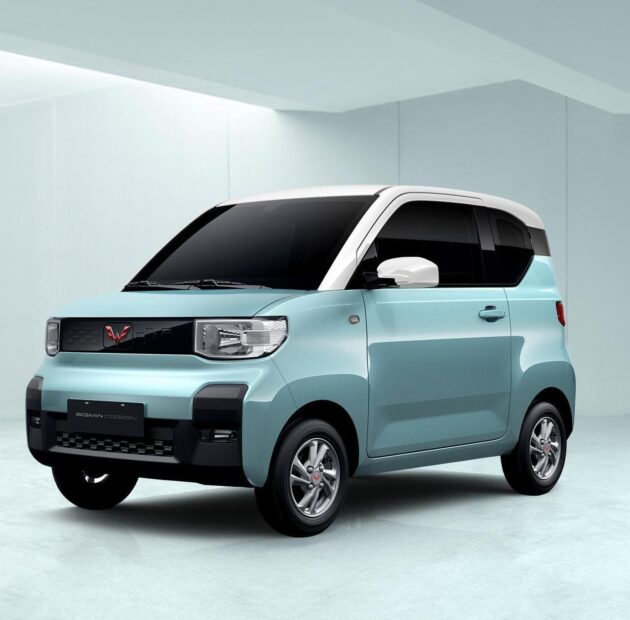
The finished products have been installed in vehicles manufactured by SAIC-GM-Wuling Automobile Co., Ltd., and applied to models such as the Wuling Hongguang MINI, Bingo and Yunhai. Simultaneously, the related technology has been extended to joint venture passenger vehicle brands such as SAIC-Volkswagen, Dongfeng-Nissan and SAIC-GM.
As of the end of September 2025, China’s total vehicle ownership reached 363 million. If each vehicle uses 40 kg of bamboo fibre, the corresponding market potential for bamboo fibre applications is approximately 14.5 million tonnes. Academician Jiang Jianchun of the Chinese Academy of Engineering stated that the industrialisation of bamboo fibre raw materials not only provides the automotive industry with green material options but also boosts the income of farmers in bamboo-producing areas, effectively contributing to rural revitalisation and achieving a win-win situation for both ecological and economic benefits.
Cover photo: Bamboo fibre composite materials have been installed in vehicles such as the Wuling Hongguang MINI (source: Wuling)